Rethinking Traditional Markets
From Traffic to Value Creation
Rethinking Traditional Markets: From Traffic to Value Creation
Traditional markets are under pressure. Foot traffic is declining, tenants are struggling and in some cases, parts of the market are losing their function altogether.
One of the most visible sources of pressure comes from the behavioral shift that accelerated during the COVID pandemic. Restrictions on movement forced consumers to rely on digital channels for everyday needs, from groceries to household items. Over time, this was no longer a temporary adjustment but became a learned habit. Consumers discovered that many of their utilitarian needs could be fulfilled more efficiently online. As a result, traditional markets are no longer competing only with nearby alternatives, but with a system that has redefined convenience, speed, and accessibility.
This is often interpreted as a traffic problem. However, traffic is only a symptom.
The deeper issue lies in how markets are positioned in the consumer’s decision-making process.
For decades, traditional markets have been managed with a clear objective which is to generate traffic. In more modern market, this has been achieved through attracting the right tenants, maintaining variety, optimizing layout and facilities and organizing events and activations. The traditional markets on the other hand rely on the habitual customers. There is not much question why traditional markets are hit harder.
Traffic is not random. It is triggered by different types of consumer needs.
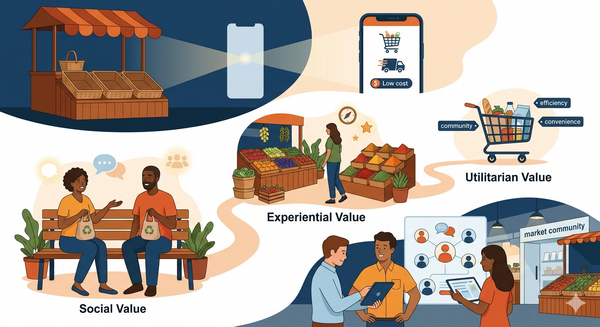
There are three elements of need that can be served by visiting the markets. It cam be utilitarian value such as product purchase, complete their decision-making process or resolve post-purchase issues. It can be experiential value such as exploration, fun and enjoyment. But there are need where physical markets can offer something beyond transactions, it is social value. Consumers are able to express their identity through their appearance and affiliation, interact with others and even seek recognition as well as belonging. Markets, in this sense, are not just places to buy, but places where people “exist” socially.
However, they definitely will not visiting market that have all the benefits. They also have to consider what they must give up. It can be money, time and effort to do so. In addition, they also need to evaluate the mental effort such as how easy or difficult it is to get there, how comfortable the experience feels or how safe and predictable it is.
This is rooted to a key insight that we all know :
Value is not absolute. It is relative to the perceived cost of obtaining it.
We can agree that online shopping outperforms physical markets in terms of the perceived cost of obtaining products. However, physical markets can be superior in delivering experiential and social value. Therefore, the competition between physical markets and online shopping is ultimately about net value. In the end, it is up to each player to decide which position best suits them.
Having said that, physical markets will find it difficult to compete on the perceived cost of obtaining products, as well as on utilitarian value. Online shopping is inherently designed to maximize efficiency in fulfilling utilitarian needs. In our view, the opportunity to compete lies in experiential and social value. This is where human interaction becomes critical and where marketing efforts should be focused.
Marketing efforts, of course, are about value creation. A critical mistake is to assume that all interactions are valuable. In reality, interaction only creates value when it is relevant to specific needs and specific users. Marketing efforts must clearly articulate the unique value they offer to shoppers in each market. We can no longer rely on habitual customers alone. We need to provide both motivation and persuasion for them to come in relation to that interaction.
In this sense, the long standing experience that traditional markets have with their customers can be put to good use. Their understanding of both visitors and tenants can provide the direction needed. And if marketing research can help, why not? 😊
Regards,
Dr. Ardi Wirdamulia
Article of the Month
Latest Article


